A retired endocrinologist explains the hidden 'cortisol lock' that keeps post-menopausal belly fat trapped in place. And the Dead Sea mineral that finally opens it.

Published April 11, 2026 · 5 min read

You've done everything right.
Counted calories. Cut carbs. Walked 10,000 steps. Tried keto, tried Mediterranean, tried whatever your doctor suggested this year.
And the belly hasn't budged.
Maybe you've even lost weight everywhere else. Your arms look fine. Your face thinned out. But that stubborn roll around your midsection? It sits there like it's bolted on.
Your doctor says it's "just part of getting older." Your bloodwork comes back normal. And you're left wondering if this is simply your new reality.
It's not. And you're not broken.
According to Dr. Julie Rosenberg, a retired endocrinologist who spent 30 years studying hormonal metabolism, the real reason most post-menopausal women can't lose belly fat has nothing to do with willpower, calories, or exercise.
The culprit is a mineral deficiency that's been silently working against you.

The Cortisol Lock
Here's what Dr. Rosenberg calls "The Cortisol Lock." And what she told us next could change the way you think about that belly for good.
After menopause, your estrogen drops. You already know that. But what most doctors never explain is what happens next.
When estrogen falls, your body loses its main buffer against cortisol. That's the stress hormone.
In a healthy body, magnesium acts as the brake pedal on cortisol. It controls how much cortisol your adrenal glands pump out.
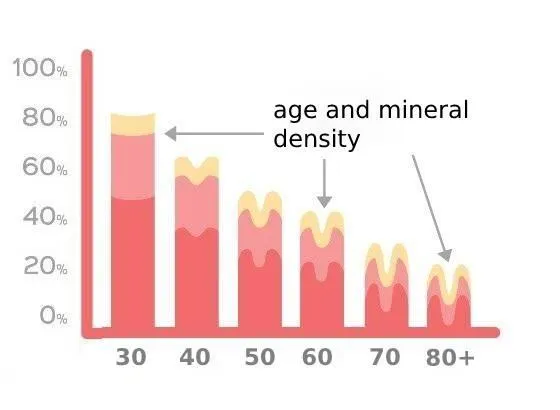
But here's the problem. 75% of American women over 60 are magnesium deficient. Not slightly low. Clinically depleted. Without enough magnesium, your cortisol has no brake pedal.
It runs around the clock. And when cortisol stays elevated like that, it does something very specific to your belly fat. It flips on an enzyme inside your abdominal fat tissue. That enzyme converts inactive hormones into active cortisol right inside your belly fat cells. Your belly fat becomes a cortisol factory. It feeds itself. It grows. And no amount of calorie cutting can override a hormonal signal telling your body to store, store, store.
That's the Cortisol Lock. Your belly fat isn't there because you eat too much. It's there because your body is chemically incapable of releasing it. The research confirms it. A 24-week clinical trial published in Clinical Endocrinology found that women aged 45 to 70 who took magnesium had significantly lower cortisol levels than women who took a placebo.
A separate study in Obesity Research found that elevated cortisol was the single strongest predictor of visceral belly fat in post-menopausal women. Stronger than diet. Stronger than exercise. Stronger than total calorie intake.
This is why "eat less, move more" stopped working for you at 55. Or 60. Or whenever your magnesium stores finally bottomed out. And if you've been blaming yourself for the belly, for the failed diets, for the willpower you thought you didn't have, you can stop now. It was never your discipline. It was a lock you didn't know was there. And your effort deserved results the whole time. But here's where the story takes an ugly turn.
Most women over 50 have tried magnesium at some point. So if it's the key, why didn't it work for you?
Because the magnesium you bought almost certainly never reached your cells.
If you grabbed a bottle off the shelf at a big-box store, you likely took magnesium oxide. That's the cheapest, most common form on the market.
Your body absorbs roughly 4% of it. The other 96% passes straight through your gut. That's where the diarrhea and cramping come from.
It never got into your cells. It never touched your cortisol. The lock stayed shut.
Or maybe you bought magnesium glycinate. That's the right form. But a 2024 class action lawsuit against Qunol revealed that many "glycinate" products are actually blended with cheap oxide.
The label says glycinate, but it's often mixed with low-quality ingredients. The industry calls this "buffering." It’s a way for companies to put a big number on the bottle while using a weaker formula to save money.
Your body knew the difference. Even if the label didn't tell you.
So what actually works? That's what Dr. Rosenberg spent years trying to figure out.
To break the cortisol-fat cycle, the magnesium has to get past your gut and into the cells where cortisol is actually regulated. That takes a very specific form: fully chelated magnesium glycinate.
Here's what "chelated" means in plain English. The magnesium is wrapped in a small protein building block. Your body doesn't treat it like a hard-to-digest mineral—it treats it like food.
It absorbs through the same doorway your body uses to absorb protein from a piece of chicken. It doesn't sit in your stomach. It doesn't cause bathroom problems. It goes where it's needed.
About 64% of it gets absorbed, compared to just 4% for oxide.
After years of watching her patients fail with grocery store magnesium, Dr. Rosenberg went looking for a formula that met every standard she'd want for her own family.
She found one—and it wasn't from a big brand.
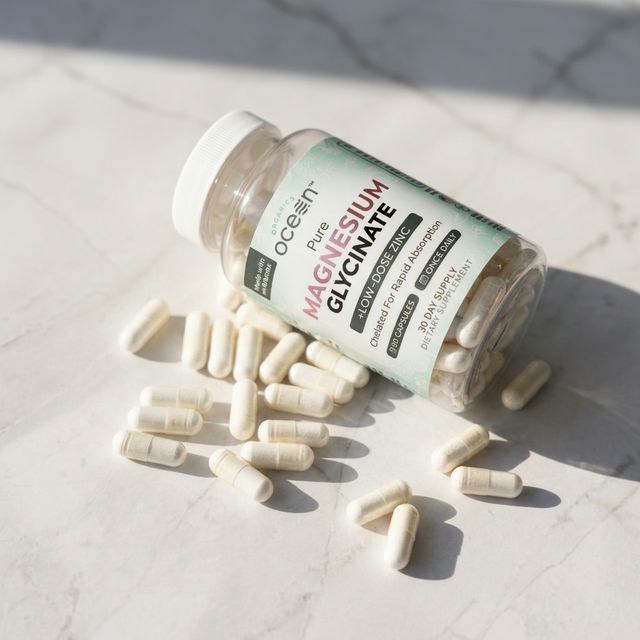
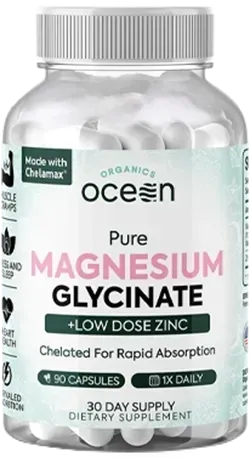
A small company called Organics Ocean sources its magnesium from the Dead Sea, one of the most mineral-dense bodies of water on earth.
The raw material is then chelated in Utah using a pharmaceutical-grade process called Chelamax. The capsules are 50% smaller than most competitors and deliver more elemental magnesium per serving.
Independent lab testing shows their heavy metal levels are 46 times lower than the industry safety standard.
Not 46% lower—46 times.
"That matters more than people realize," Dr. Rosenberg says. "Lead and arsenic are common in magnesium sourced from China. And those heavy metals actually raise cortisol and inflammation. So a contaminated supplement doesn't just fail to help you—it makes the Cortisol Lock worse."
The formula also includes a low dose of zinc. Zinc supports the sleep pathways that cortisol disrupts.
And that matters because broken sleep raises cortisol, and cortisol keeps the lock shut. Zinc helps close the loop.
→ See If This Magnesium Is Still in Stock
"I was getting stressed and anxious, and my cortisol was through the roof. I wasn't losing weight—I was gaining it. After taking this, not only is the weight dropping but my sleep is so much better. I've tried other brands and this one far exceeded my expectations." — Maria R., 56, Tampa, FL
"I'm 62 and I'd accepted that the fatigue, brain fog, and belly bloat were just part of aging. My doctor said 'manage stress.' After 3 weeks, I started sleeping through the night for the first time in years. By week 6, my jeans were looser and my mind felt sharp again. This isn't a diet pill—it's what my body was missing." — Karen T., 62, Portland, OR
"Every night I'd wake up at 3am with my heart racing. Nothing worked. Within 2 weeks, I was sleeping 7 hours straight." — Debbie M., 57, Austin, TX
Dr. Rosenberg tells her patients that changes tend to come in a specific order:
"The mineral isn't a diet," Dr. Rosenberg says. "It's the reason your body can finally respond to your effort again."

Organics Ocean's Pure Magnesium Glycinate is the only non-buffered, Dead Sea-sourced, heavy-metal-verified formula Dr. Rosenberg recommends to her patients.
Right now, they're running a limited spring promotion—up to 50% off, with free shipping on orders of 3 or more bottles.
Every order comes with a 90-day money-back guarantee. If you don't feel a difference in your sleep, your energy, or your waistline, send the bottles back—even if they're empty—and you'll get a full refund. No questions asked.
→ Check Spring Pricing and Availability
One thing worth knowing: this magnesium is not sold in stores, on Amazon, or at Costco. The Dead Sea minerals are extracted in small batches, and the chelation process takes over 8 weeks per run.
Organics Ocean has sold out several times this year. And with their spring promotion driving record orders, current stock is moving fast.
If you can still see the promotion on the next page, bottles are available.
→ See If the Spring Deal Is Still Available
"I spent 30 years telling women to eat less. I was wrong. They weren't undisciplined. They weren't failing—they were depleted. And no one told them. Once you fix the depletion, the body does what it was always trying to do. The lock opens. And the weight finally moves."

I kept seeing ads for Magnesium Glycinate, so when I saw a discount and 30-day money back guarantee I decided to try! After about a week of taking it 2 times a day (I know it says 1 time but I really love how it makes me feel :D), I can gladly say that I feel AMAZING!!!
Megan Tailor,
54 years old
I LOVE it! Such an easy way to start my wellness journey. The order came quickly and it's so easy to take 😊 I'm so looking forward to seeing my change. Thank you!
Wendy Swanson,
48 years old
© COPYRIGHT, Magnesium Glycinate 2026
MARKETING DISCLOSURE: This website promotes certain products. As such you should know that the owner has a monetary connection to the product and services advertised on the site. Rest assured, we only state what we believe in.
ADVERTISING DISCLOSURE: This website and the products & services referred to on the site are advertising marketplaces. This website is an advertisement and not a news publication. Photographs of persons used on this site are the brand’s material or the actual product users.
†HEALTH DISCLAIMER: This website is not intended to provide medical advice or replace medical advice and treatment from your physician. Visitors are advised to consult their own doctors or other qualified health professional regarding the treatment of medical conditions. This site offers health, wellness, fitness, and nutritional information and is designed for educational purposes only. Do not disregard, avoid or delay obtaining medical or health-related advice from your health-care professional because of something you may have read on this site. The use of any information provided on this site is solely at your own risk. The author may share his or her personal experience which does not intend to override any medical authorities’ or recommendations. The U.S. Food and Drug Administration has not evaluated the statements on this website. The information is not intended to diagnose, treat, cure, or prevent any disease.